How to start forex trading in 2026 with a simple plan for beginners
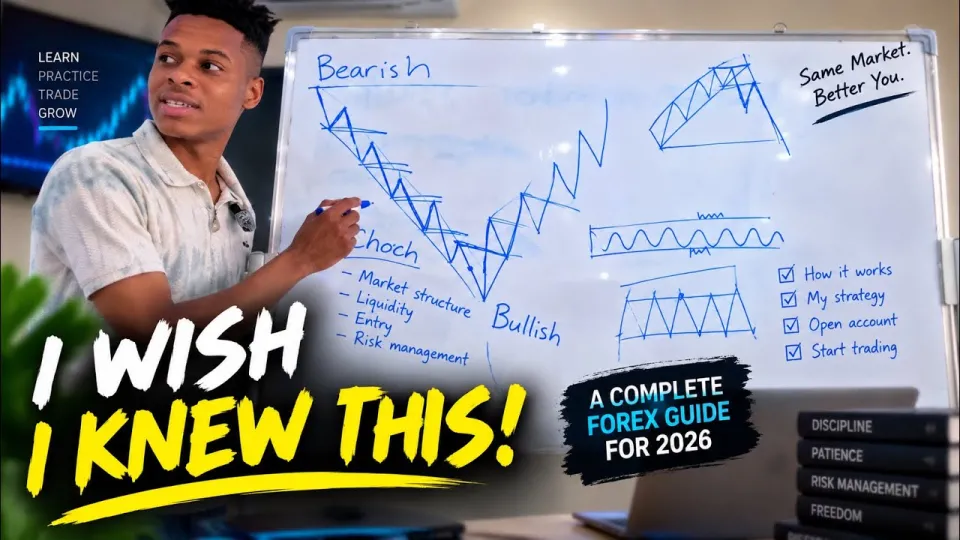
Video: How To Start Forex Trading For Beginners in 2026 (Full Guide + My Strategy)
Need articles like this for your video? They help promote it on YouTube and Google — order them in the Telegram bot @sat_sit_bot. The bot writes and publishes the articles itself (with your YouTube video embedded) on popular topical websites (no ads). Free trial — 50 articles.
· based on the channel Carl Fx
Key takeaways
- Forex is a decentralized over-the-counter market where currencies are traded in pairs 24 hours a day, five days a week.
- Start with a demo account and a small real deposit: the goal of the first months is process, not profit.
- Carl Fx, author of the guide, breaks the beginner path into four steps: account, market structure, strategy, risk management.
- Bullish markets make higher highs and higher lows; bearish markets make lower highs and lower lows.
- Trading with leverage can wipe out an account quickly, so risk per trade should stay in the 1–2% range.
To start forex trading in 2026, open a demo account with a regulated broker, learn to read market structure on a single currency pair, practise one simple strategy on a fixed risk per trade, and only then move to a small live account. The mechanics are not complicated; what takes time is the discipline to follow the same process every week. The guide below follows the beginner roadmap Carl Fx lays out on his channel, including his own brokerage sign-up link for opening a trading account with TFC Global Markets.
What forex trading actually is and how the market works
Forex is the market where national currencies are exchanged in pairs, and the price you see is simply how much of the quote currency one unit of the base currency costs. When you trade EUR/USD, you are buying euros with dollars, or selling euros for dollars — there is no physical delivery, only a contract whose value moves with the exchange rate. Unlike a stock exchange, forex has no central floor: it runs over-the-counter through a network of banks, brokers and liquidity providers, which is why it operates around the clock from Monday morning in Asia to Friday evening in New York.
The main sessions are Asia, London and New York, and the busiest overlap is London–New York, when spreads tighten and ranges expand. Most brokers quote pairs as lots: one standard lot is 100,000 units of the base currency, a mini lot is 10,000 and a micro lot is 1,000, so beginners usually trade micro lots while learning. Prices are quoted with a bid (what buyers pay) and an ask (what sellers accept), and the difference — the spread — is the broker's cost to you on every trade. Leverage is offered on top of that, letting you control a position far larger than your deposit; it magnifies both gains and losses, which is why risk control comes before strategy.
The four-step path from zero to your first trade
Getting started is a sequence of small, testable steps rather than one big leap into the live market. Carl Fx structures the beginner route around opening an account, learning structure, applying a strategy and managing risk — in that order.
- Choose a broker and register. Compare regulation, spreads, execution and deposit methods, then complete identity verification (KYC) before funding anything. A demo account is available at the same time and costs nothing.
- Learn the platform. Practise placing market and pending orders, setting stop loss and take profit, and reading your position size in lots on the demo until it feels routine.
- Study market structure and price action. Learn to mark swing highs and lows, trends and ranges on a clean chart before adding any indicator.
- Backtest and forward-test one strategy. Run it on historical charts, then on demo for several weeks, and record every result so you know your real win rate and average risk-to-reward.
- Go live small. Fund an amount you can afford to lose entirely, keep risk per trade at 1–2% of the account, and treat the first months as paid practice.
Reading bullish and bearish markets through market structure
Market structure is the map of swings that tells you who is in control, and price action is the study of how candles behave at those swings. In a bullish market, price prints higher highs and higher lows; in a bearish market it prints lower highs and lower lows. A trend stays valid until that pattern breaks — the first sign of a shift is a failure to make a new extreme, followed by a break of the most recent swing point.
Practical reading looks like this: mark the last clear swing high and swing low on your timeframe, note whether each new push exceeds the previous one, and only look for longs while the sequence of higher lows holds, or shorts while lower highs hold. Ranges are the third state, where price bounces between a ceiling and a floor, and most beginner losses come from trading range edges as if they were breakouts. Keep the chart clean: one pair, one or two timeframes, and a handful of marked levels is enough to start.
A simple strategy a beginner can actually follow
A workable beginner strategy is built from three decisions — where to enter, where you are wrong, and where you take profit — and it should be boring enough to repeat. Carl Fx's approach is price-action based: wait for a clear directional bias, wait for price to pull back to a level rather than chasing it, and enter only when the setup matches the plan you already wrote down.
A practical version of that template:
- Bias: decide direction from the higher timeframe using the swing structure described above.
- Zone: mark the area price is likely to react to — a previous swing high or low, or a level that has already been respected more than once.
- Trigger: wait for a rejection candle or a structure break inside that zone instead of entering on the first touch.
- Stop loss: place it beyond the swing that would invalidate your idea, not at an arbitrary number of pips.
- Target: aim for at least twice your risk so a modest win rate still leaves you profitable, and move to break-even only when the plan allows it.
Log every trade with a screenshot, the reason for entry and the result. After 30–50 trades the log will show which part of the template is failing — entry timing, stop placement or patience — and that is the part to fix first.
Risk management rules that keep a beginner account alive
Risk management is the difference between a learning curve and a blown account, and it matters more than any indicator. A common benchmark is risking 1–2% of the balance per trade: at 1% risk, ten consecutive losses cost about 10% of the account, which is recoverable; at 10% risk, the same streak removes most of it. Position size follows from that rule — the distance to your stop loss and the pip value of the pair determine how many lots you can open, not the other way around.
Three more rules do most of the work: never add to a losing position, avoid trading around major data releases and central bank decisions unless that is part of the plan, and set a daily or weekly loss limit that ends the session when hit. Leverage should be treated as a tool for sizing, not as a way to increase returns. Brokers advertise ratios of 1:100 or higher, but a trader risking 1% per trade rarely uses more than a small fraction of the maximum available.
Common beginner mistakes and the questions new traders ask most
Most beginner failures repeat the same patterns, and recognising them early saves months of losses. The most frequent is starting live too soon, skipping demo entirely or leaving it after a few days; the second is switching strategies after two or three losing trades, so no method ever gets a fair test. Others include trading too many pairs at once, moving stop losses further away to avoid being stopped out, and sizing positions by how confident the trader feels rather than by the risk rule.
Questions from newer traders tend to cluster around a few practical worries. Many ask how much capital is needed to begin — the honest answer is that the amount matters less than the risk percentage, so a few hundred dollars on a micro account is enough to practise the process properly. Others worry about the technical side of opening a real account, such as verification documents and deposit methods; that is a broker support question, and completing KYC before you plan to trade removes most of the friction. Some viewers ask for chart examples, which is the strongest argument for keeping a screenshot journal: your own marked-up charts teach more than anyone else's. And a recurring doubt is whether the material can be grasped at all — the answer is that structure and one strategy are a few weeks of study, while consistency takes months of recorded trades.
Useful links
- Open a trading account with TFC Global Markets — the broker sign-up link shared by Carl Fx, who discloses that he owns the brokerage.
- Carl Fx Telegram community — free channel with trade discussion and updates.
Bottom line
Forex in 2026 rewards process over prediction: a regulated account, a clean chart, one strategy tested on demo, and a hard risk limit per trade will take a beginner further than any indicator. The roadmap Carl Fx presents — account, market structure, strategy, risk — is deliberately unglamorous, and that is the point; trading is a skill built from recorded repetition, not a shortcut to fast money. If you are ready to start, you can register with TFC Global Markets through the Carl Fx link and begin on demo before funding anything. The full walkthrough is on the Carl Fx channel, which also covers trading lifestyle and personal growth alongside the charts.
Questions & answers
How much money do I need to start forex trading?
There is no fixed minimum, but the risk rule matters more than the deposit. With 1–2% risk per trade, a few hundred dollars on a micro-lot account is enough to practise the full process, and a demo account costs nothing while you learn.
Should I start with a demo account or a live one?
Start on demo until placing orders, setting stop losses and sizing positions feels automatic, then move to a small live account. Demo removes financial pressure but not the need for a written plan and a trade journal.
What is market structure and why does it matter?
Market structure is the pattern of swing highs and lows that shows whether buyers or sellers control price. Higher highs and higher lows indicate a bullish market, lower highs and lower lows a bearish one, and a break of that sequence signals a possible shift.
Why do most beginners lose money in forex?
The usual causes are starting live too soon, abandoning a strategy after a few losses, risking too much per trade, and moving stop losses to avoid being stopped out. A fixed risk limit and a trade log address most of these problems.
Source: How To Start Forex Trading For Beginners in 2026 (Full Guide + My Strategy) · Markdown version